Eine LED (auf Englisch: Light Emitting Diode) ist wie eine kleine Lampe, die zwei Beinchen hat: eine Anode (+) und eine Kathode (–). Wenn du die Beine korrekt mit einer Batterie verbindest, leuchtet die LED. Die LED lässt den Strom nur in eine Richtung fließen.
WICHTIG: Es ist jedoch ratsam, immer einen Widerstand davor zu schalten.


ACHTUNG! Wenn du die Beinchen falsch steckst, leuchtet deine LED nicht:
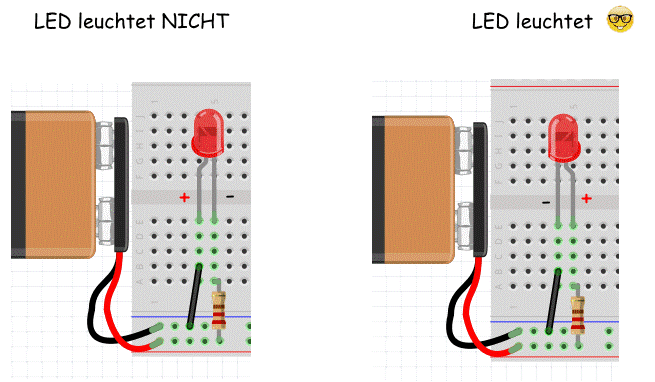
Die POLARITÄT kannst du KURZ mit einer 3V-Batterie ausprobieren:


RG–LED
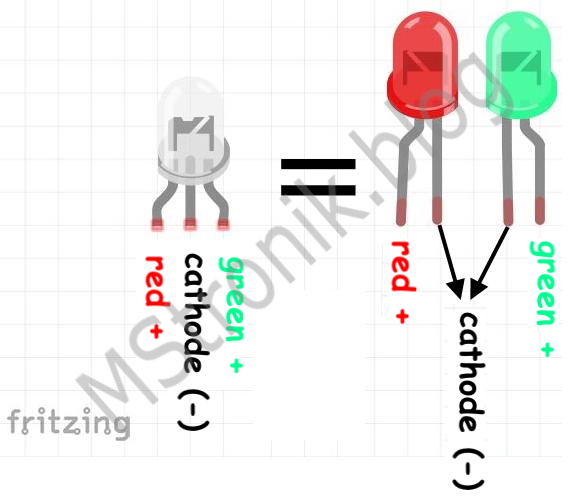
Eine RG-LED hat innen zwei LEDs kombiniert, eine rote und eine grüne, welche eine gemeinsamer Kathode oder eine gemeinsamer Anode haben.
RG-LED mit gemeinsamer Kathode:

Verbinde zwei Widerstände mit den beiden Anoden (rot + und grün +) und achte darauf, dass alle Verbindungen richtig sind bevor du die Batterie verbindest!

RGB–LED
Eine RGB-LED hat innen drei LEDs kombiniert, eine rote, eine grüne und eine blaue welche eine gemeinsamer Kathode oder eine gemeinsamer Anode haben.
RGB-LED mit gemeinsamer Kathode (-):

ACHTUNG: Schaue genau auf die Richtung der Beine der RGB-LED:
Das längste Beinchen ist in dieser Fall der Minuspol oder Kathode.

RGB-LED mit gemeinsamer Anode (+):

Das längste Beinchen ist in dieser Fall der Pluspol oder Anode.
LED
A LED (short for Light Emitting Diode) is like a small lamp that has two legs: an anode ( + ) and a cathode ( – ). If you connect the legs correctly to a battery, the LED will light up. It allows the current to flow ONLY in one direction:

IMPORTANT: it is always advisable to connect a resistor between the LED an the battery.

You can test the polarity of the LED, connecting it for a short time to a 3V battery:
You can find LEDs in many different colors and shapes:


RG – LED
A RG-LED has two LEDs combined inside, a red and a green LED, which have a common cathode or a common anode.
RG-LED with common cathode:

RGB – LED
A RGB LED has three LEDs combined inside, a red, a green and a blue LED which have a common cathode or a common anode.
ATTENTION: Look carefully at the direction of the legs of the RGB LED.
RGB-LED with common cathode (–):
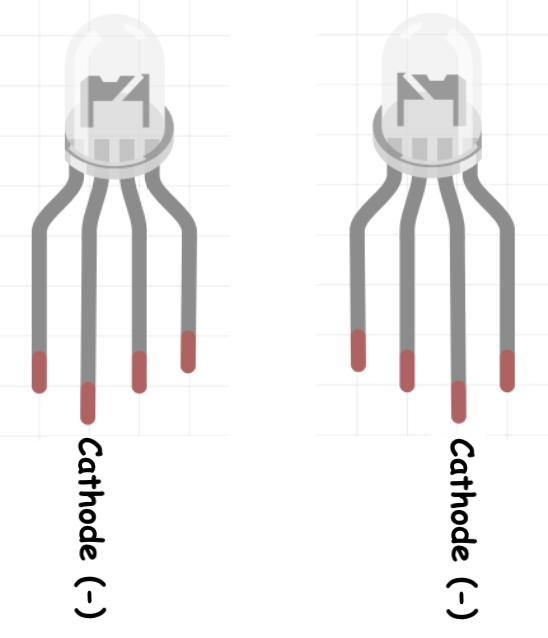
In this case, the longest leg is the negative pole or cathode.
RGB-LED with common anode (+):
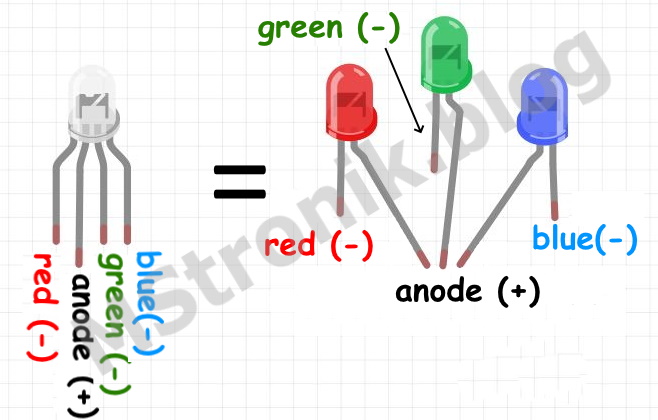
In this case, the longest leg is the positive pole or anode.

 MStronik
Hinterlasse einen Kommentar